ISRO Successfully Tests Key Separation System for Gaganyaan Mission
1. What Has ISRO Achieved in the Latest Gaganyaan Test?
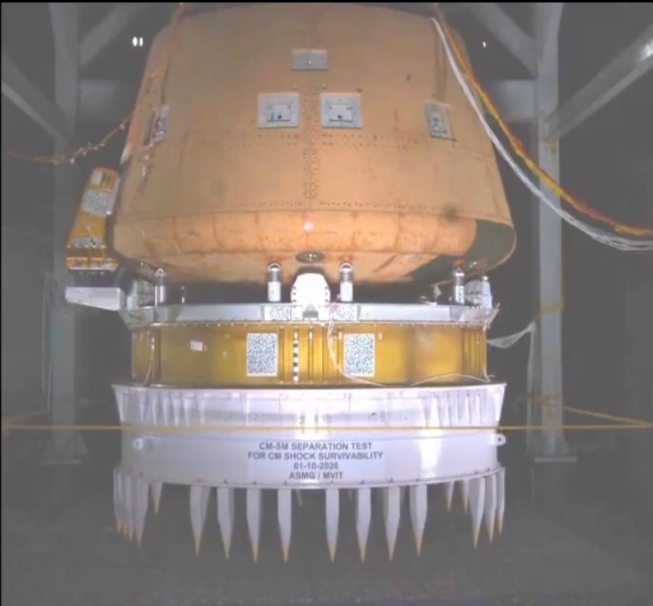
The Indian Space Research Organisation (ISRO) has successfully completed a series of Crew Module–Service Module separation tests for its Gaganyaan human spaceflight programme. Announced on October 16, 2026, the tests were designed to validate the system responsible for separating the astronaut capsule from the spacecraft’s service section before its return to Earth. The achievement marks another step in preparing India’s first human spaceflight mission.
2. Where Were the Separation Tests Conducted?
The tests were conducted at the Vikram Sarabhai Space Centre (VSSC) in Thiruvananthapuram, Kerala. ISRO developed an extensively instrumented test setup that simulated the combined Crew Module and Service Module assembly. The experiments recreated the separation process, including the disconnection of electrical and fluid connections between the two modules, allowing engineers to assess the system’s overall design and performance.
3. What Are the Crew Module and Service Module?
The Crew Module is the spacecraft section designed to carry astronauts and provide the protective environment needed during their journey and return to Earth. The Service Module supports the spacecraft with essential systems and services. Before launch, both modules are connected and function together during the mission’s orbital phase. Before atmospheric re-entry, the Crew Module separates from the Service Module and begins its return journey.
4. Why Is the Separation System Important for Astronaut Safety?
The separation process involves several carefully timed events, including pyrotechnic devices and mechanisms that disconnect the modules. ISRO’s tests assessed the system’s design and demonstrated the ability of critical Crew Module subsystems to withstand the shocks associated with separation. These included avionics, inertial navigation equipment, thermal protection components and systems related to crew-module recovery and environmental control. Reliable separation is essential for the capsule’s safe return.
5. What Is the Next Major Step for the Gaganyaan Programme?
The successful tests will support preparations for Gaganyaan’s first uncrewed mission, designated G1. ISRO has stated that this mission is targeted for launch in 2026. Before sending astronauts into space, the programme must demonstrate that its launch vehicle, spacecraft, life-support-related systems and recovery mechanisms can operate safely. The separation tests form one part of this wider qualification and validation process.
6. What Does This Achievement Mean for India’s Human Spaceflight Ambitions?
The latest test results represent progress in validating technologies required for India’s independent human spaceflight capability. However, the successful ground tests do not mean that Gaganyaan has already launched or that all mission preparations are complete. Further integration, testing and verification remain essential before the mission can proceed. ISRO’s next milestones will determine how the programme advances towards its first uncrewed flight and, eventually, a crewed mission.